


Tips to Improve Sleep
A lack of sleep can create a vicious cycle of poor lifestyle choices. Energy levels, motivation and will power can be left wanting after a
Explore how your passion for nutrition and well-being can blossom into a rewarding and fulfilling career as a Nutrition & Health Coach. Are you ready to take the first step on a journey that will not only transform your life but also enable you to transform the lives of others?
Our internationally recognised BTEC qualification is your passport to a thriving industry where knowledge, compassion, and expertise come together to make a profound impact on people’s lives.
In a world where individuals are becoming increasingly aware of the impact of poor diet and lifestyle on well-being, the path to lasting change often seems elusive. However, with our Nutrition & Health Coaching qualification, you will hold the key to empowering clients to achieve their health and wellness goals. By providing motivation, education, valuable resources, and unwavering support, you’ll guide them on a transformative journey, making lasting positive changes not only possible but achievable.
Join us in shaping a healthier future, one client at a time.
Our internationally recognised Nutrition & Health Coaching programme is accredited by Pearson (BTEC), the world’s largest awarding body for education. Pearson approve and monitor the curriculum and assessment standards, and routinely audit students’ work. This way you can be assured that the content you are learning is up to date and of the highest standard.
The course is also accredited by the NHS Personalised Care Institute and approved as a “Gold Standard” by the UKIHCA, the global professional body for Health Coaching. Students and Graduates are eligible to apply for Complementary Medical Association Membership as they have demonstrated their commitment to excellence by choosing to train with IINH.
At IINH, we are proud to now be a member of (International Institute for Complementary Therapists). This partnership means our students and graduates can access comprehensive insurance packages that provide real peace of mind and professional security as they begin their careers.
*No additional add-on courses are required to gain our BTEC accreditation
Enrolment is open for September 2026 with Early Bird Discounts applied.
12 month instalment option also available until 31st March 2026.
Sign up now and begin learning today with a FREE Short Course! ( *CPD Certified )
Choose from 6 targeted areas to deepen your expertise:
To discuss future course dates speak with our admissions team, contact admissions@iinh.net
Early Bird ends 3rd August 2026.
Online Course: This 10 month course is delivered fully online for all students. Most students report devoting between 8 and 12 hours a week to the course, including study time, live learning sessions, further reading, assignments and case studies.
Basic computer skills essential. In Person Events and Live Cookery attendance days offered. (optional)
Speak with our admissions team, with no obligation, by clicking the links below.
Our team are all IINH graduates who have been in the position you are in now and would be happy to answer any questions you may have.
Our course structure is based on giving you the full tool set to help nurture a lifelong career in Nutrition and Health Coaching.
Our Nutrition & Health Coaches and Nutritional Therapists are active in over 50 countries – and counting!
Throughout his working life, Richard Burton has explored ways of improving the diet of individuals and society as a whole. At various times since the 1970s, he has been involved in: nutrition research on dietary fibre; science writing for research projects; health journalism; managing wholefood businesses; consulting and lecturing on nutrition at London’s Community Health Foundation; weight management consulting; nutritional therapy, and acupuncture. Richard’s therapeutic approach has achieved successful outcomes for thousands of clients. His knowledge of Chinese Medicine enriches his teaching and counselling skills.
Richard founded IINH in 2002 with a mission to spread understanding of nutrition and health, and to educate, motivate and train as many people as possible to do the same. He is principal tutor for the Nutrition & Health Coaching programme.
Founder & Director of IINH BSc (Hons Nutrition) MBANT, MNTOI, Dip Ac
This vocational qualification offers practical, hands-on learning, engaging case study work, and interactive experiences with real clients, so that you can feel confident as you set out as a newly qualified Nutrition & Health Coach.
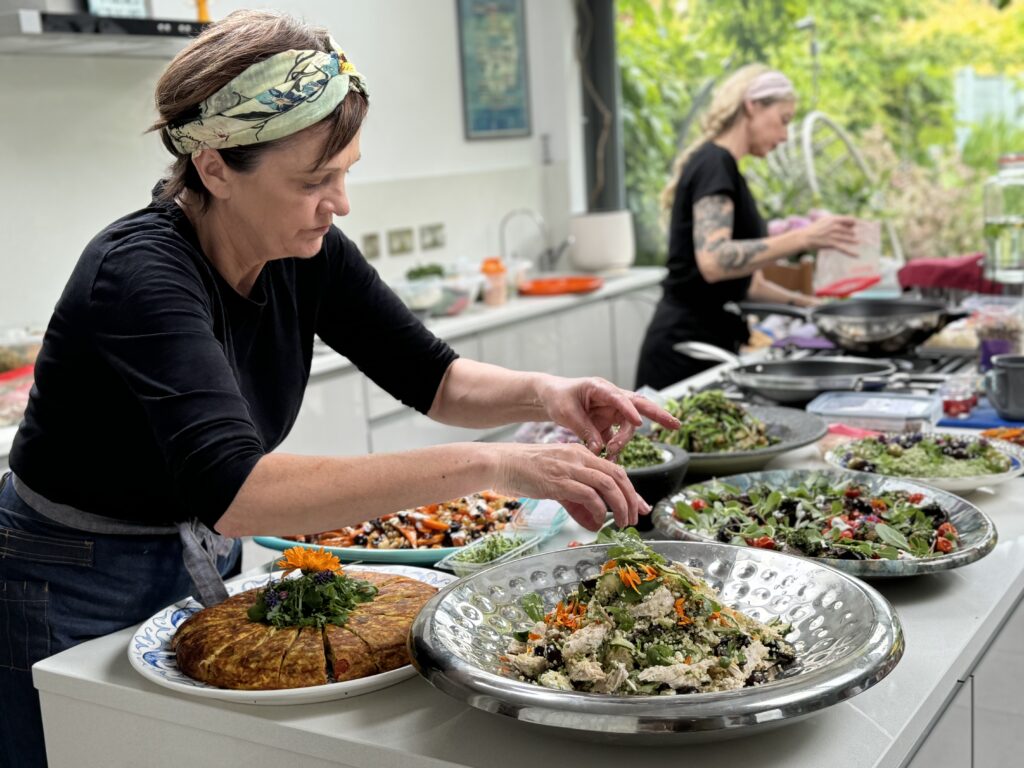
Find inspiration in dishes that are both tasty and balanced with our Director of Cooking Studies Maggie Lynch. Maggie blends her twin passions of cooking and nutrition into demonstration classes both live and online, themed around health issues.
Did you know that IINH Nutrition & Health Coaching and Nutritional Therapy students get access to 450+ delicious recipes developed by our very own Maggie Lynch, to support them in providing their future clients with tasty options to help boost their health?
Materials and Live Sessions covering:
Business Online Workshop Day
Students explore practical tools, strategies and insights to help their coaching business flourish.
Online Event Day, exclusive for IINH Students. Learn from key industry speakers covering subjects such as:

One of the most frequently asked questions we get is ‘What is the difference between a Nutrition & Health Coach and a Nutritional Therapist?’ We have created a handy table to explain the differences between these two rapidly growing fields
Course content is accessible on our learning platform 24/7, to enable you to fit your learning around your busy schedule. Content for modules is released in the form of handouts, podcasts and videos, ahead of the live learning sessions, so that you can review all of the content in your own time and come to the sessions with any questions you may have for our expert tutors.
This vocational qualification offers practical, hands-on learning, engaging case study work, and interactive experiences with real clients, so that you can feel confident as you set out as a newly qualified Nutrition & Health Coach.
At IINH, we prioritise a personalised approach to education, providing individualised attention and support to every student. During the course you will be supported with:
* Live Learning Sessions are recorded for those unable to attend
BTEC Diploma in Professional Nutrition and Health Coaching is a higher education award accredited by Pearson (BTEC), the world’s largest awarding body for education.
BTEC are vocational qualifications, this means that you will gain hands-on experience with real clients during your case studies, giving you practical experience before you have qualified. You are supported throughout this portion of your studies with a personal mentor.

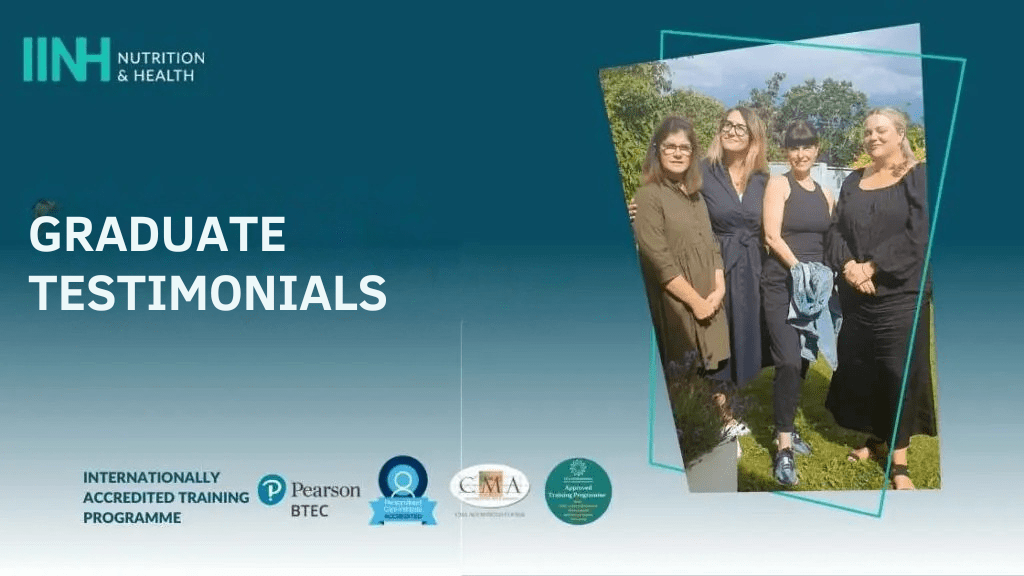
See what some of our pioneers in nutrition have to say about their experiences of studying with IINH.
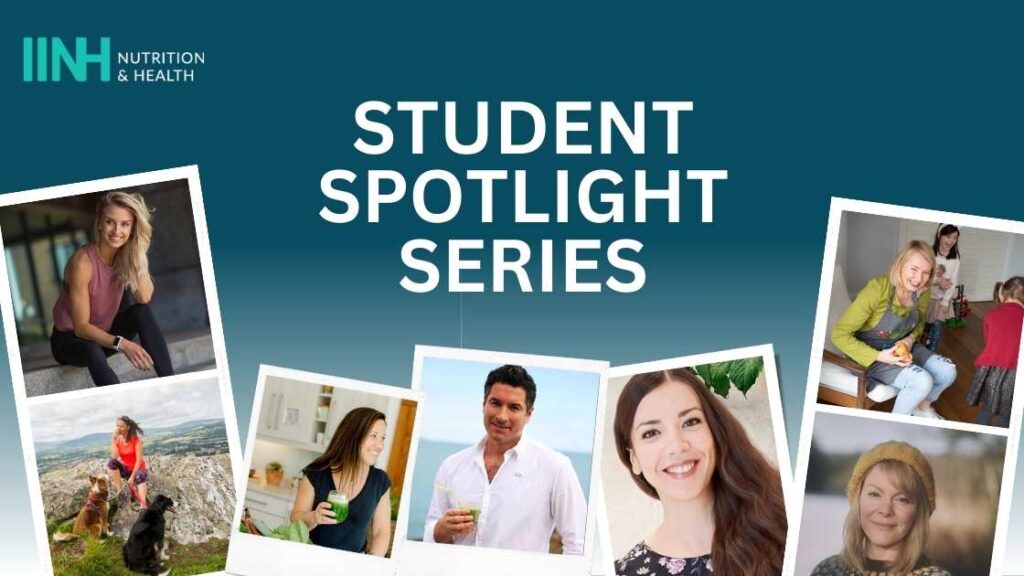
Read about some of our graduates’ experiences and what they have gone on to do with their qualifications.
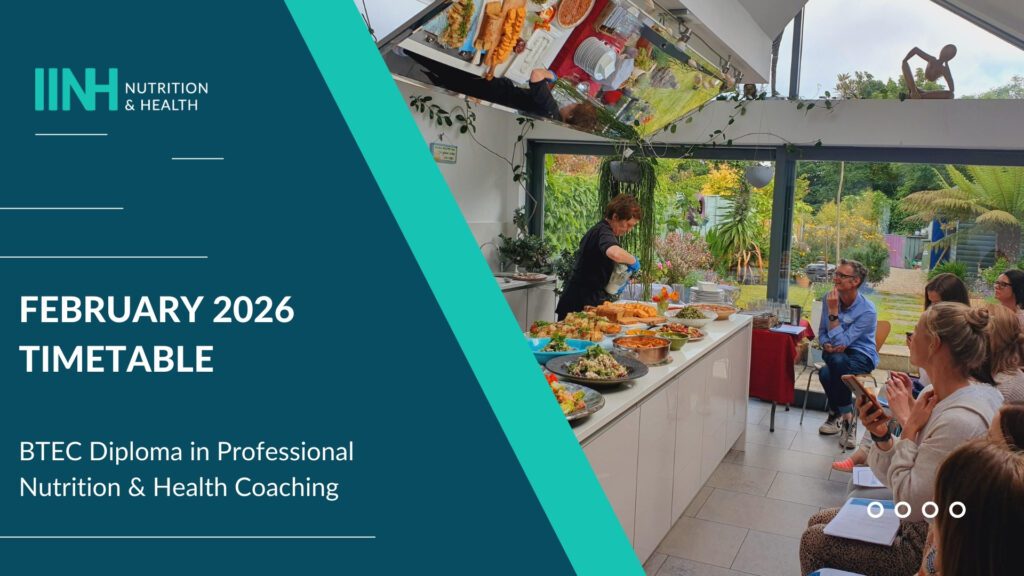
Download the sample schedule for our Nutrition & Health Coaching Programme beginning in September.
The BTEC Diploma in Professional Nutrition & Health Coaching programme consists of ten assessed units, plus cooking and Mindful Self-Compassion training program. 10 course units, 600 estimated learning hours
This unit will introduce you to historical developments, current challenges and recent advances in nutrition and health. Concepts, terms and tools used in nutrition research, in public health and by the diet and food industry are explored.
This unit will equip you with knowledge, skills and practice to create and develop a client-led collaborative health coaching relationship. This includes facilitating learning and achieving results with the client through communicating effectively while fostering learner competency.
You will demonstrate coaching competence when working with volunteer clients through genuine case studies as well as reflecting on your growing competence by tracking your own skill development. In this unit as a learner coach, you will become familiar with the principles, processes and competencies of health coaching, through a framework for developing coaching skills.
This unit will provide you with an understanding of the importance of the digestive system and how it functions. Good eating supports health and well-being, while a poor diet has the potential to create digestive disorders and ill health.
This unit covers digestion and absorption processes, including key factors of appetite, hunger and satiety. You will appreciate how dietary habits and other lifestyle factors, such as chronic stress, can impact digestive activity and how appropriate dietary adjustments may benefit health. You will develop an understanding of the importance of nurturing a healthy microbiome by consuming a diverse diet of minimally processed foods.
The background knowledge and understanding this unit provides will help you to develop the knowledge and skills they will need to safely and effectively propose suitable dietary and lifestyle adaptations to support optimum digestive processes.
Since the 1950s, intensive industrial farming of crops and animals has largely come to replace traditional agricultural practices, with impacts on the environment and human health.
You will investigate sustainable developments in crop production and animal husbandry, including organic farming, and how these contrast with industrial farming in terms of soil quality, productivity, environmental impacts, food miles, animal and worker welfare. You will gain an overview of how key food items are produced, processed and brought to market. Exploring refining processes used to make sugar, wheat flour and cooking oils will offer insights into nutritional quality concerns about the modern diet.
The aim of this unit is to provide you with awareness of food product marketing messages, as well as the nutrition and health claims, ingredients and nutrition data provided on food labels, in order to inform choices for healthy and lower-cost options. By failing to use information on food packaging labels, shoppers may not realise that healthy food products can also be inexpensive.
You will develop knowledge and skills to evaluate the nutritional profiles and nutritional value for money of food products based on marketing, ingredients, nutrition data, health and nutrition claims and cost, in order to facilitate better informed choices when shopping.
You will explore categories of additives and their use, with special focus on those that may lead to health problems in some individuals.
This unit addresses some key nutrition and health concerns at different stages of life, from preconception through to old age. It also looks at how chronic stress can be managed to reduce the impact on people’s lives.
Cultivating sound dietary and lifestyle behaviours supports health and life quality from preconception through to old age. Continuing to prioritise healthier habits as we age helps to reduce lifestyle-related chronic illness and maintain quality of life during the later years.
This unit looks at food consumption trends and the rise of metabolic diseases. How these disorders develop is examined, along with diet and lifestyle factors to help address them. You will be taught to assist clients to identify and manage food sensitivities. You will examine evidence for and against popular diets used for health and weight issues.
This unit looks at weight management problems. You will understand problems and models of weight control. You will be taught to assist clients to use a personalised diet and exercise in successful weight control.
Weight management problems remain the dominant reason for interest in diet and nutrition. With so many people struggling to manage their weight, a nutrition and health coach needs to understand the obesogenic environment. You should be familiar with key dietary, epigenetic and lifestyle factors driving the obesity epidemic.
The aim of this unit is to provide learners with the knowledge and skills required to set up a practice, and deliver presentations, as a nutrition and health coach.
For success as a nutrition and health coach it is vital for you to develop effective communication, business and organisational skills. This unit will guide you on the essential legal, administrative and professional aspects that must be considered for setting up a nutrition and health practice.
Business Online Workshop Day
Students explore practical tools, strategies and insights to help their coaching business flourish. Online Event Day, exclusive for IINH Students. Learn from key industry speakers covering subjects such as:
ADDITIONAL GUEST SPEAKER LIVE SESSIONS
To establish healthy eating habits, wholesome food must be both tasty and enjoyable. An effective nutrition course should provide practical knowledge and skills for preparing wholesome foods and meals. To meet this crucial need, we have established our own dedicated cooking school and the purpose-built ‘Taste Health’ demonstration kitchen.
Maggie Lynch, our Director of Cooking, hosts two live online cooking classes via Zoom from the IINH Taste Health kitchen as part of our Nutrition & Health Coaching Diploma. Students attending these classes can get their cooking and food related questions answered by Maggie.
Everyone receives a comprehensive pack of delicious wholefood recipes catering for a cross section of dietary needs and preferences. Maggie generously shares a wealth of tips on how to adapt each recipe, making it possible to create entirely new variations from the original. She also provides tips on how to modify her recipes to accommodate various dietary preferences and food intolerances.
The tips include many handy nuggets, such as: how to store dishes when cooked, sourcing ingredients, and much more. Her special skill lies in creating healthy, wholesome recipes that the whole family will enjoy.
Students also receive support packages containing practical information that they can share with their families, friends and future clients.
These include:
Live Attendance Cook Days – coaching
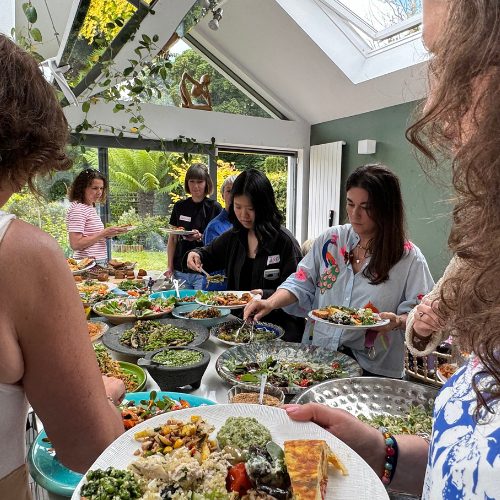
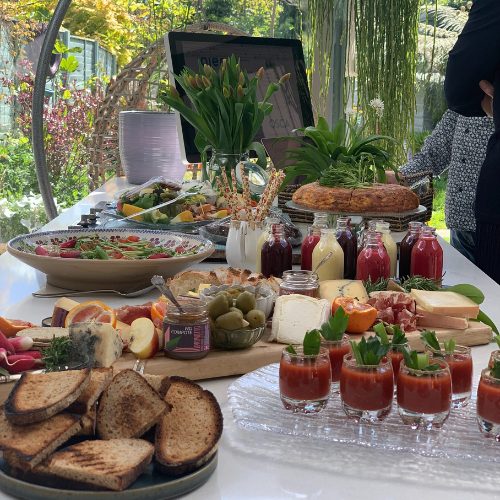
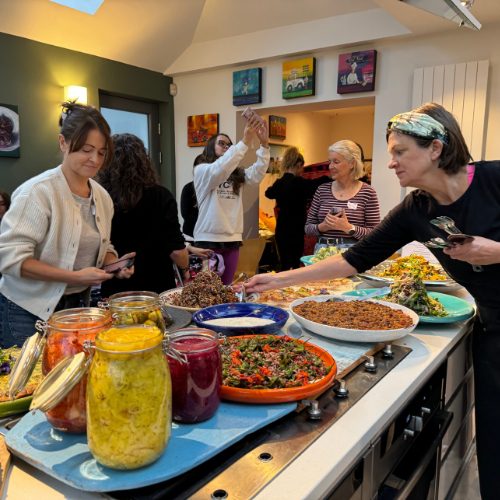
We also host two attendance cooking class days during the course at an additional cost of €50 for those who wish to experience the magic of our Taste Health Kitchen in-person. Maggie and her team demonstrate a dozen or more delicious dishes from scratch and provide a wonderful buffet spread at the end.
At Taste Health we enjoy everything in moderation, including – if you wish – a glass of organic wine to accompany the delicious dishes demonstrated on the day! This also allows more time to get to know class buddies, ask any lingering questions and nourish your soul.
Self-Compassion Training for Healthcare Communities (SCHC) is a 6-week, evidence-based, adaptation of the Mindful Self-Compassion (MSC) programme. MSC is the empirically supported program of Dr. Kristin Neff (UT Austin) and Dr. Chris Germer (Harvard Medical School).
This abbreviated MSC training programme was specifically designed for healthcare professionals and is very relevant to all Caregivers. It is therefore something we are delighted to offer to our Nutrition and Health Coaches as part of their studies.
This training aims to improve wellbeing and personal resilience in professionals in the caring professions. It aims to do this by teaching mindful self-compassion skills to deal with distressing emotional situations as they occur at work and at home. Here at IINH we teach the programme in 6 x 90-minute weekly sessions as part of the Nutrition and Health Coaching course.
Burgeoning research is showing that self-compassion skills can be of particular benefit to people in caregiving professions, allowing them to experience greater satisfaction in their caregiving roles, less stress, and more emotional resilience.
In research published in the Journal of Clinical Psychology, Neff.Knox.2020, the SCHC program was found to significantly:
As opposed to other self-care techniques, self-compassion practices can be used on the spot at work with clients or colleagues or at home. These skills, although requiring an intentional daily effort to integrate, do not require extra time or formal meditation practice.
Participants of the programme will learn skills and tools to use throughout the day to:
We have included this abbreviated version of the MSC programme in the Coaching programme to give our students the opportunity to learn some of these vital skills.
This programme will be facilitated by Julia Sweetman, Certified MSC teacher, Nutritional Therapist and Programme Director for our Nutritional Therapy course.
To find out more about Mindful Self Compassion please see https://centerformsc.org/
The assessment is based on a variety of mainly practical assignments and case studies. There is no written exam.
The IINH Scope of Practice is a document that outlines the framework in which the IINH Nutrition & Health Coach may work, once qualified.
Try us out for FREE! Sample some of our course content, learn more about our additional units and get a tour of our learning platform.



 | Thank you for Signing Up |


| Cookie | Duration | Description |
|---|---|---|
| cookielawinfo-checkbox-analytics | 11 months | This cookie is set by GDPR Cookie Consent plugin. The cookie is used to store the user consent for the cookies in the category "Analytics". |
| cookielawinfo-checkbox-functional | 11 months | The cookie is set by GDPR cookie consent to record the user consent for the cookies in the category "Functional". |
| cookielawinfo-checkbox-necessary | 11 months | This cookie is set by GDPR Cookie Consent plugin. The cookies is used to store the user consent for the cookies in the category "Necessary". |
| cookielawinfo-checkbox-others | 11 months | This cookie is set by GDPR Cookie Consent plugin. The cookie is used to store the user consent for the cookies in the category "Other. |
| cookielawinfo-checkbox-performance | 11 months | This cookie is set by GDPR Cookie Consent plugin. The cookie is used to store the user consent for the cookies in the category "Performance". |
| viewed_cookie_policy | 11 months | The cookie is set by the GDPR Cookie Consent plugin and is used to store whether or not user has consented to the use of cookies. It does not store any personal data. |
A lack of sleep can create a vicious cycle of poor lifestyle choices. Energy levels, motivation and will power can be left wanting after a
What is Health Coaching? Health coaching is a profession based on supporting clients in a holistic and integrated manner. Health coaching promotes proactive health which
Whatever your goal in the gym, you won’t be able to neglect your diet for too long. It’s quite evident that what you eat has
What is Epigenetics? Put simply, epigenetics is the study of mechanisms that switch on or off our genes. These mechanisms are hugely influenced by our

At IINH, our graduates are very important to us and we wish to create a space where they can continue on their journey with us and know they have our full support and guidance in reaching their end goals.