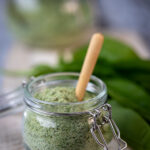
Wild Garlic Salt
Sorry, everyone, I should have posted this earlier in the season, but there’s still time to gather the last of the wild garlic leaves while you’re out for a stroll. It’s well worth it. You’ll end up with a deeply savoury condiment that can lift all sorts of dishes year-round. Sprinkle it over eggs, vegetables, grilled fish, chicken or warm, buttered potatoes. Rub it onto meat before roasting, or sprinkle a little dusting over sliced tomatoes with your favourite extra virgin olive oil.
Course Seasoning, Store Cupboard Staple
Cuisine International, Mediterranean
Servings 1 Medium Kilnar Jar (550g)
Equipment
- 1 oven and tray
Ingredients
- 50 g wild garlic leaves roughly chopped, tough stems removed
- 500 g coarse salt rock or Himalayan
Instructions
- First, make a wild garlic salt paste. Add 50g of the salt and the chopped wild garlic to a blender, Vitamix or Nutri Bullet and blitz briefly until you have a thick, vibrant green mixture and the salt has fully absorbed the garlic. Transfer to a bowl, then stir in the remaining salt.
- Spread the mixture evenly onto a parchment-lined baking tray and place in a very low oven at 40°C overnight - roughly 18 hours or until the salt has completely dried out.
- Return the dried mixture to the blender or Vitamix and blitz again until the salt becomes a fine powder.
- Spoon the salt into a dry, sterilised Kilner jar and store in a cool, dry place, ready to enjoy.
- Use to season whatever takes your fancy — perhaps not desserts.
Maggie's Tips
A note on wild garlic:
- A member of the onion/garlic family, also known as ‘ramsons’, wild garlic grows abundantly in our hedgerows and woodlands, filling the Spring air with its pungent scent. The bright green shoots with pretty white flowers bopping in the breeze are free to forage and make a lovely addition to many dishes. The entire plant is edible; the bulbs can be used like normal garlic.
- Choose the small, tender leaves of wild garlic – they have a milder flavour.
- Don’t pick from busy areas where dogs tend to roam, and always wash thoroughly before use. This applies to all foraged foods.
- Wild garlic leaves keep well in the fridge for up to a week (sometimes longer) if stored in a paper bag or a glass container with a lid.
- Wild garlic has antibacterial, antibiotic, antiseptic and antifungal properties. It is also rich in folic acid.
- Wild garlic oil can react with metal lids, hence the Kilner jar with a glass lid.
- Nut-free option: Omit. No need to replace with anything.
- Dairy-free/Vegan option: Omit parmesan. You can replace it with 1 small avocado or leave it out completely.
- As the salt dries, it can develop a strong sulphurous aroma. Don’t let that put you off. Wild garlic naturally contains sulphur compounds, much like regular garlic, and this is simply part of the drying process. Once blended and used in cooking, the flavour becomes mellow, savoury and wonderfully rounded. This is one of those useful little kitchen staples you’ll keep reaching for again and again.